MvFFN: Multi-view Floor Plan Feed-Forward Network for Unposed Wide-Baseline Panorama Layout Reconstruction

NeurIPS 2026

1University of Washington    2Independent Researcher    *Equal contribution

From a handful of unposed 360° panoramas to accurate multi-room floor plans. MvFFN introduces MOIS, a novel formulation for learning cross-view wall identity and connectivity, enabling single-pass prediction and automatic layout assembly.

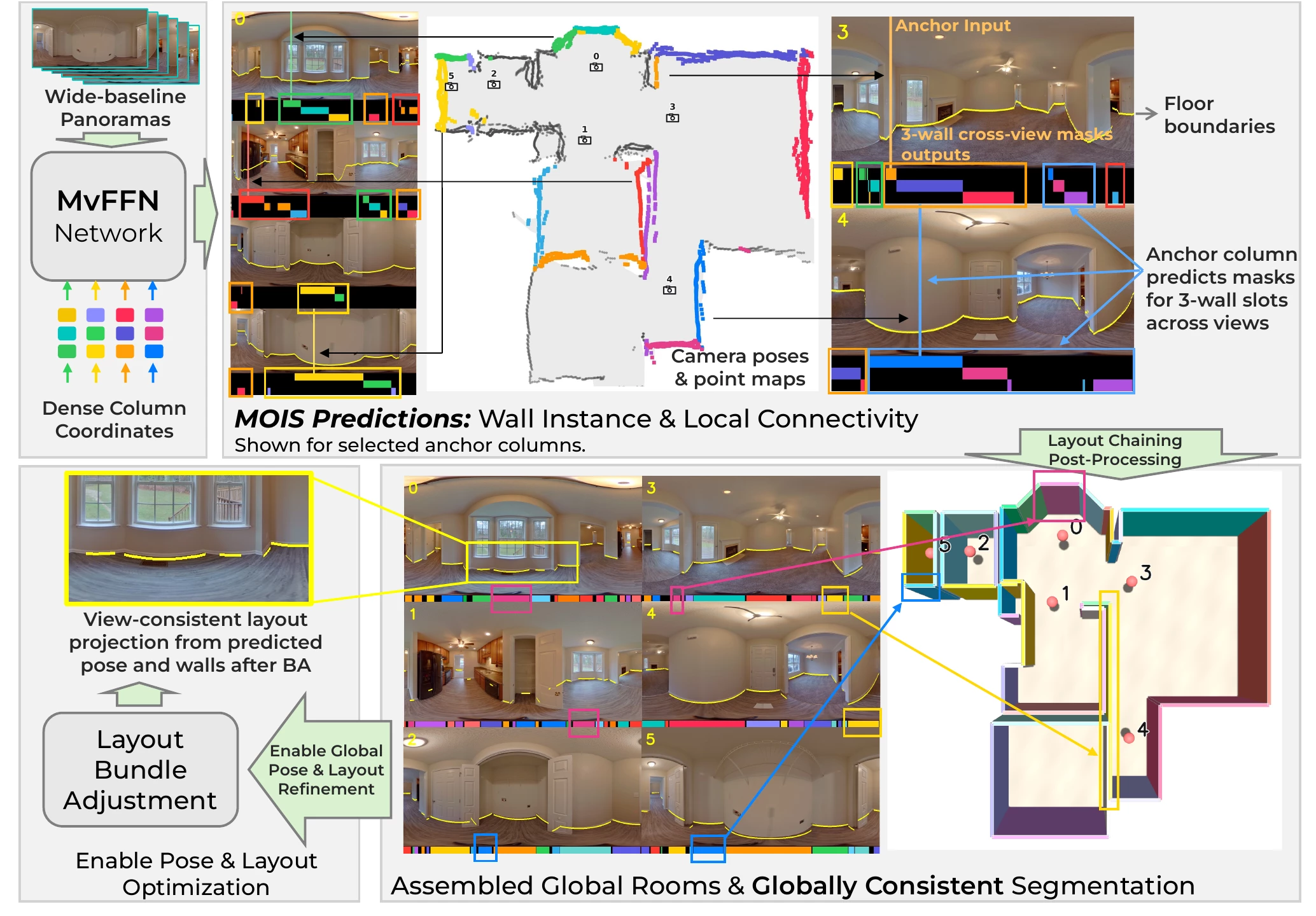
MvFFN pipeline from wide-baseline panoramas through cross-view wall predictions and layout chaining to an assembled floor plan.
Overview. Local cross-view wall predictions are assembled into a global floor plan.

Objective

Complete floor plans from sparse, unposed panoramas.

Existing pipelines estimate camera poses and room layouts separately, so errors compound and geometric refinement still needs manual wall matches. MvFFN predicts pose, geometry, and cross-view wall relationships together, enabling automatic global assembly and BADGR refinement from only a few widely spaced 360° photos.

Why MvFFN?

The formulation

MOIS makes the problem local

Multi-view Ordered Wall Instance Segmentation replaces one difficult whole-floor prediction with dense, column-by-column supervision. For each panorama column, MOIS identifies the same physical wall across views and its two neighboring walls inside the room. These local decisions are easier to learn under partial visibility and noisy poses, while still carrying the identity and connectivity needed for global reconstruction.
The network

MvFFN joins geometry and semantics

MvFFN is a feed-forward multi-view transformer with separately trained geometry and semantic branches. Its geometry encoder follows VGGT’s alternating frame-wise and global attention pattern, adapted from perspective-image patches to panoramic column tokens. It predicts 3-DoF camera poses and dense geometry; the semantic branch combines image features with the frozen geometry features to predict MOIS wall relationships.

The supervision

ZInD-XV connects walls across views

ZInD-CrossView extends ZInD with globally consistent wall IDs, column-to-wall assignments, and cross-view segmentation labels. Standard floor-plan annotations do not say which image columns observe the same wall; ZInD-XV supplies exactly that supervision and makes MOIS training possible.

The downstream benefit

Wall correspondences unlock BADGR

Layout Chaining converts MOIS predictions into global wall instances and pixel-to-wall correspondences. Those associations provide the initialization that planar bundle adjustment and BADGR need to jointly refine camera poses and wall geometry, removing the previous manual correspondence step and enabling fully automatic refinement.

+17%wall reconstruction score
+25%corner reconstruction score
Comparablecamera-position accuracy

Qualitative Results

ZInD-XV

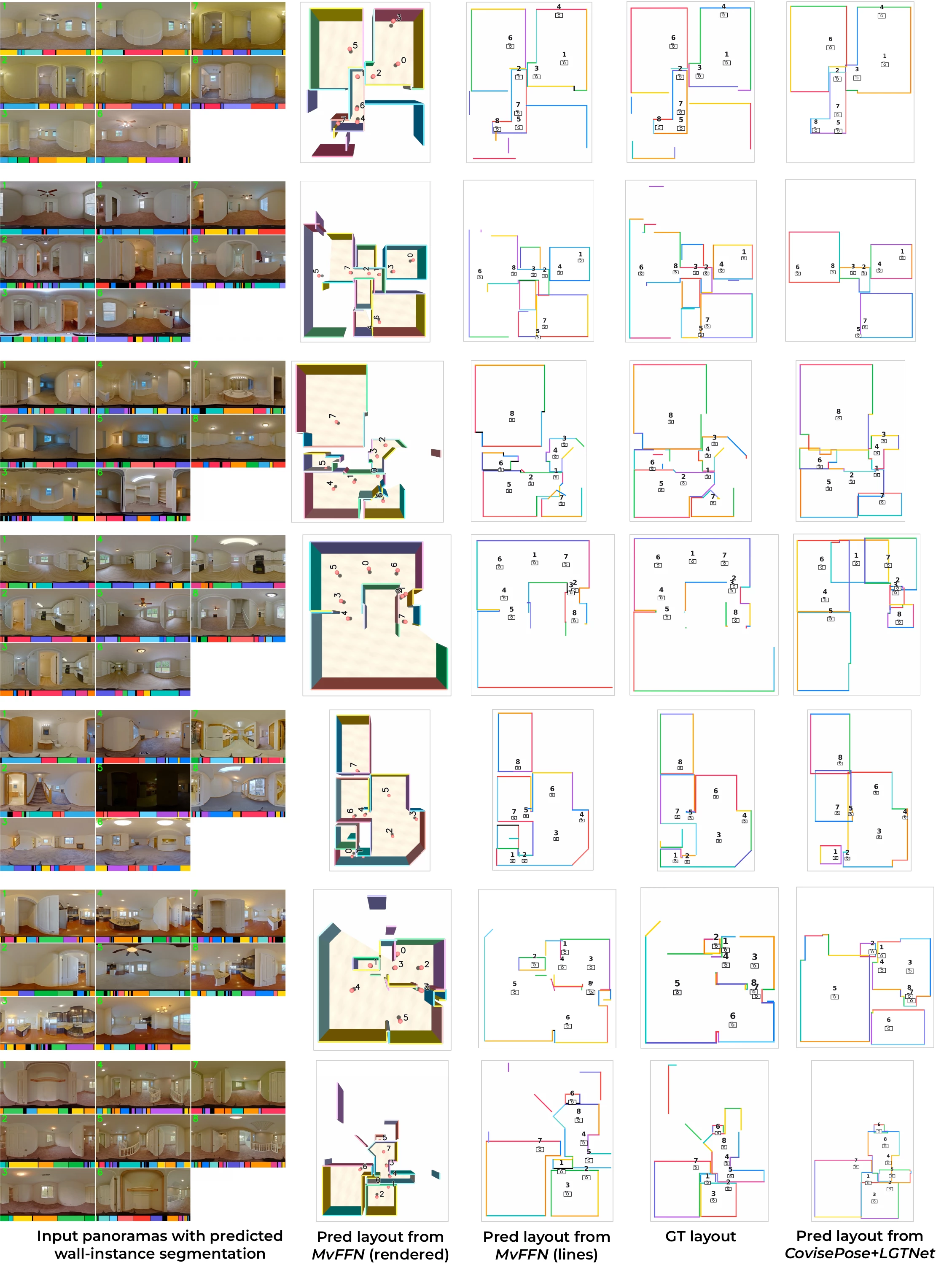
Qualitative comparisons of MvFFN layouts, ground truth layouts, and the CovisPose plus LGT-Net baseline on ZInD-XV.
Predicted wall instances, MvFFN layouts, ground truth, and the modular baseline.

HM3D-XV

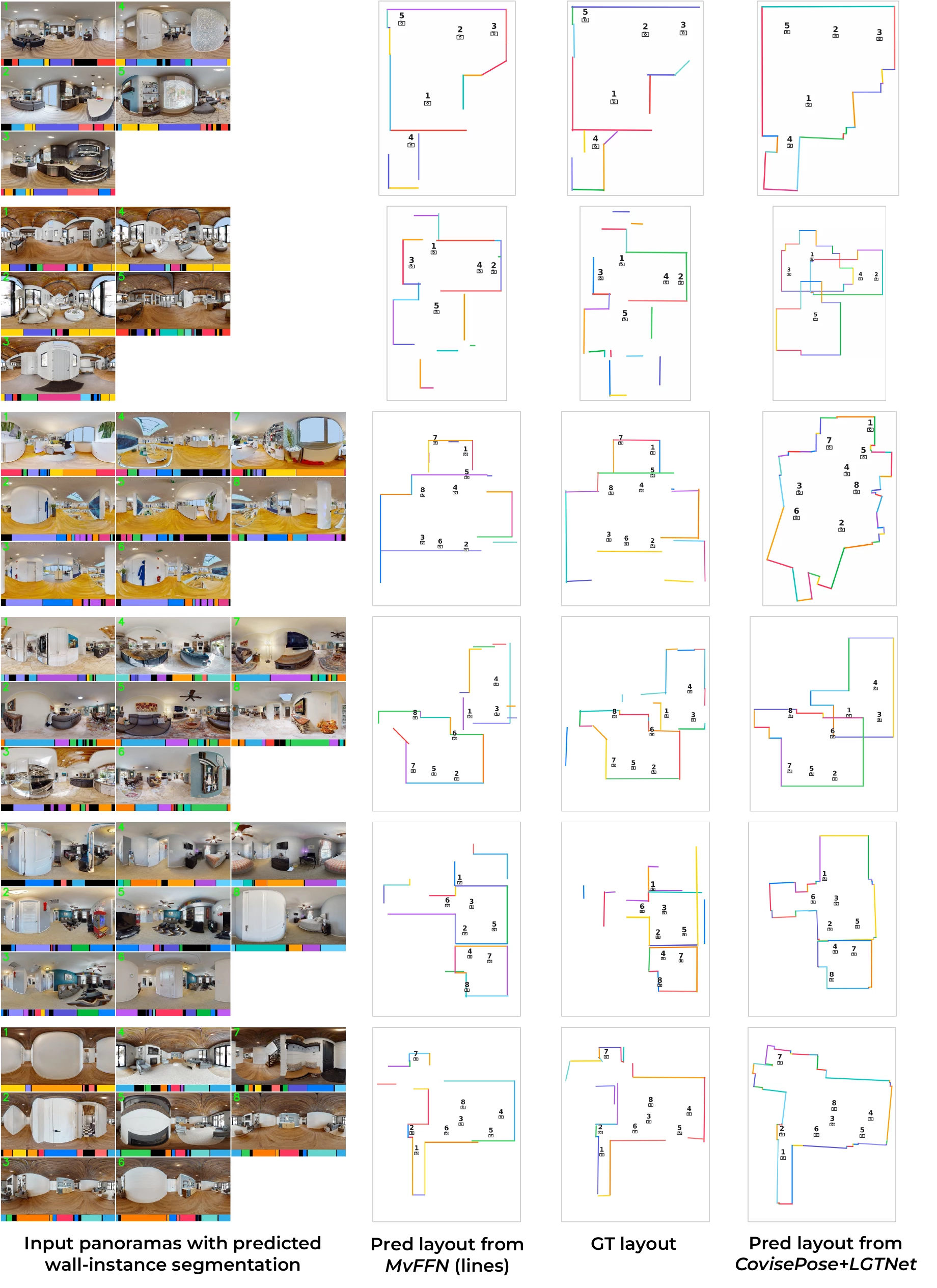
Qualitative comparisons of MvFFN layouts, ground truth layouts, and the CovisPose plus LGT-Net baseline on HM3D-XV.
Representative reconstructions under furnished, mesh-rendered domain shift.

Citation

@inproceedings{li2026mvffn,
  title     = {MvFFN: Multi-view Floor Plan Feed-Forward Network for Unposed Wide-Baseline Panorama Layout Reconstruction},
  author    = {Li, Yuguang and Deng, Yichuan and Liu, Zixuan and Boyadzhiev, Ivaylo and Wu, Xiuyuan and Zou, Xinyu and Shapiro, Linda and Colburn, Alex},
  booktitle = {Advances in Neural Information Processing Systems},
  year      = {2026}
}